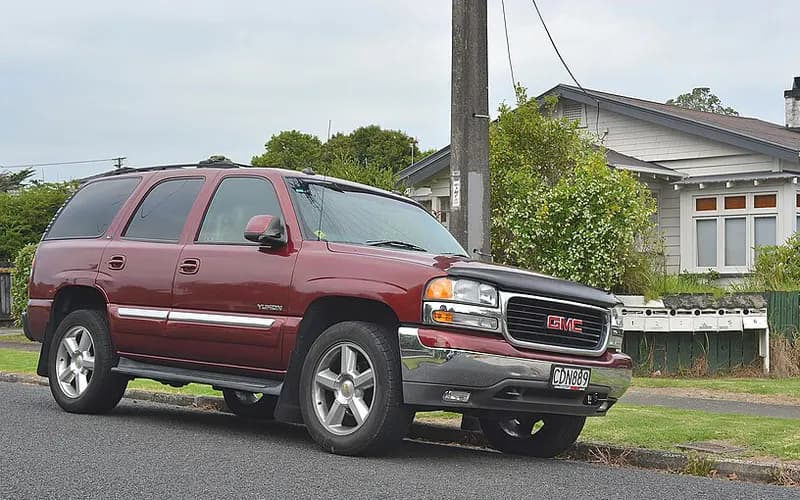
GMC Yukon 2000–2006
Common on this vehicle:Warning lightReduced brakingNoiseABS activates (at low speed and the like)Corrosion or rustSeat beltSmoke or fireAir bag did not deploy
Possible causes
10 causes not drawn
- Engine knock on cold start (carbon on piston)0
- Exhaust pop or ping noise (replace the heat shield, not the exhaust system)0
- Fuel pressure regulator buzz / hum after replacement (check fuel pump feed voltage drop and connector crimps)0
- Engine compartment noise with A/C on and A/C inoperative (auxiliary rear A/C: suction hose and compressor)0
- HVAC actuator clicking / ticking noises (recalibrate the HVAC control module, do not replace actuators)0
- Rear HVAC ticking noise, no rear temperature or mode control, DTC B0434 / B3764 (revised auxiliary HVAC control module)0
- Tire recall (not the vehicle as built): Firestone Wilderness LE tread separation - recall 01T-0010
- Power steering pump whine between idle and 2000 rpm0
- Steering intermediate shaft clunk0
- Tire scrub noise on low speed turns (steering rod / centerlink installed backwards)0
The documents say what to doOnly records name itThe size of a node, the width of a link and the numbers are records matching this search, not likelihoods.
FaultCrate・GMC Yukon 2000–2006・Noise, ABS light
Candidate cause (the documents say what to do)
Unwanted ABS activation at low speed (front wheel speed sensor mounting corrosion)
These vehicles may have a condition permitting corrosion to occur between the front hub/bearing assembly and the wheel speed sensor.
With the brakes applied between about 6 km/h (3.7 mph) and 16 km/h (10 mph), the corrosion may cause unwanted ABS activation.
What to do
- The reading should be at least 350 mV AC; if it is less, the wheel speed sensor must be replaced.
- If the sensor's mounting surface is warped or bent, the sensor must be replaced.
- Dealers remove the sensor, clean its mounting surface on the bearing, apply rust inhibitor and grease, reinstall it and check peak-to-peak output voltage.
- The passage heading states that the repair is cleaning the wheel speed sensor mounting surface.
- The recall procedure is to remove the sensor, clean the mounting surface, apply a rust inhibitor (Zinc-X) to the surface and reinstall the sensor; the sensor is replaced if necessary.
- GM's earlier recall procedure in Canada also included greasing the mounting surfaces and verifying that the wheel speed signal output voltages were within specification.
Caution: Do not pry the sensor out of the bore; prying breaks the sensor body off in the bore.
In the records
No record states work done for this cause.
See the evidence (1 technical documents, 1 records)
Passages of the technical documents
MODELS: 1999-2002 CHEVROLET SILVERADO 2000-2002 CHEVROLET TAHOE, SUBURBAN 2002 CHEVROLET AVALANCHE 1999-2002 GMC SIERRA 2000-2002 GMC YUKON, YUKON XL LOCATED IN THE SEVERE CORROSION AREAS LISTED BELOW
General Motors (recall bulletin filed with NHTSA under 05V-379) 2008-03-01
THIS CONDITION IS MORE LIKELY TO OCCUR IN ENVIRONMENTALLY CORROSIVE AREAS.
NHTSA (recall summary text as published by NHTSA)
THIS RECALL WILL BE LAUNCHED IN THE "SALT BELT" STATES OF CONNECTICUT, DELAWARE, ILLINOIS, INDIANA, IOWA, MARYLAND, MASSACHUSETTS, MAINE, MICHIGAN, MINNESOTA, MISSOURI, NEW HAMPSHIRE, NEW JERSEY, NEW YORK, OHIO, PENNSYLVANIA, RHODE ISLAND, VERMONT, WEST VIRGINIA, WISCONSIN AND THE DISTRICT OF COLUMBIA ONLY.
NHTSA (recall summary text as published by NHTSA)
These vehicles may have a condition permitting corrosion to occur between the front hub/bearing assembly and the wheel speed sensor.
General Motors (recall bulletin filed with NHTSA under 05V-379) 2008-03-01
A cause or a result a complaint states is the owner’s view or what a dealer told them, not an established fact.
Put together by FaultCrate from public records and technical documents. The cause and the repair are for the workshop to decide with the vehicle in front of it. Counts are records, not failure rates.