GMC Yukon 2000–2006
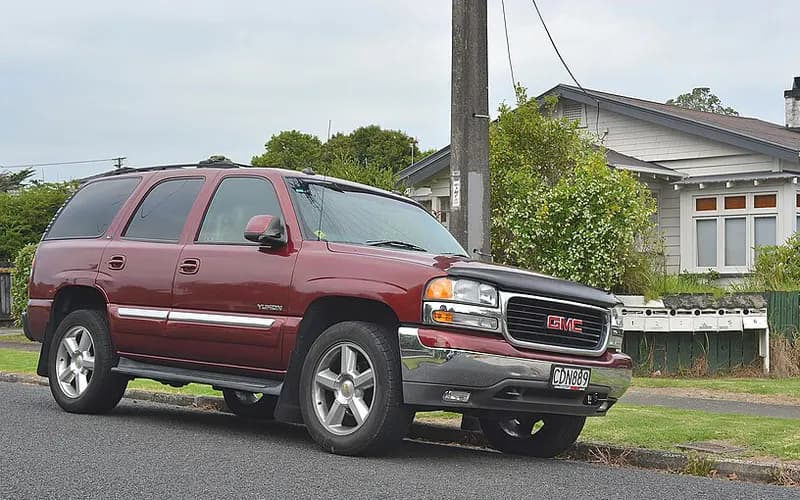
Common on this vehicle:Warning lightMisfire or rough idleLoss of engine power, no accelerationLeakNoiseGauge or instrument faultHard start or long crankDoes not start
Record by record
3 records state a cause or a remedy. Each record is shown as short labels in the order fault → finding the cause → correction. Press a label to narrow to the records that state it.
Component named as the cause
Work done
A ribbon is as wide as the records that state both of its ends (only the commonest are drawn). A record that names several symptoms or components runs through each. Orange is records that say the fault came back or was not fixed. Results come from owners’ reports only; one that does not say is “result not stated”. None of this is a likelihood of a cause or a rate at which work succeeds.
Read the records one by one (2)
ENGINE AND ENGINE COOLING2
Manufacturer communication2000–2006 GMC YUKON DENALI ・ 2017-08-15(1 earlier editions of this document folded here)
Engine Check Lamp P0442 Evaporative Emissions System Notification
1Fault
- The service engine soon lamp (MIL) is on for DTC P0442, but a leak cannot be verified with the system test in the service information.
2Finding the cause
Steps to confirm (in the document’s order)
- With the scan tool, command the EVAP system CLOSED, start the engine and watch the tank pressure sensor value for about two minutes.
- If the tank pressure value changes (shows vacuum), remove the purge solenoid and pressurize its fuel tank side with the GE 41413-A / J 41413-A tester.
- If the tank pressure value does not change, install the CH-48096 adaptor between the purge line from the canister and the purge solenoid; use no other adaptor or pressurization method.
- With the EVAP system CLOSED, pressurize through the adaptor and let the system stabilize, watching the gauge for at least 5 minutes, then add smoke.
- Look for smoke or UV trace fluid at the purge solenoid, the engine side, the fuel cap or capless fill door, and the canister vent solenoid filter or fresh-air line.
3Correction
Repair
- If smoke passes through the purge solenoid, replace the purge solenoid.
Caution
- After verifying P0442, do not disturb any fuel system component before testing.
- Test pressure must not exceed 13 in H2O (0.5 PSI (= 3.45 kPa)); more can make components perform inaccurately and lead to misdiagnosis.
- A large temperature difference between vehicle, shop and tester seriously affects accuracy; let the vehicle adjust to shop temperature first.
Read the sentences of the record
From the manufacturer’s document
- Applies to:Applies to 2016 and prior passenger cars and trucks.
- Condition:The service engine soon lamp (MIL) is on for DTC P0442, but a leak cannot be verified with the system test in the service information.
- Caution:After verifying P0442, do not disturb any fuel system component before testing.
- Confirm:With the scan tool, command the EVAP system CLOSED, start the engine and watch the tank pressure sensor value for about two minutes.
- Confirm:If the tank pressure value changes (shows vacuum), remove the purge solenoid and pressurize its fuel tank side with the GE 41413-A / J 41413-A tester.
- Repair:If smoke passes through the purge solenoid, replace the purge solenoid.
- Confirm:If the tank pressure value does not change, install the CH-48096 adaptor between the purge line from the canister and the purge solenoid; use no other adaptor or pressurization method.
- Confirm:With the EVAP system CLOSED, pressurize through the adaptor and let the system stabilize, watching the gauge for at least 5 minutes, then add smoke.
- Confirm:Look for smoke or UV trace fluid at the purge solenoid, the engine side, the fuel cap or capless fill door, and the canister vent solenoid filter or fresh-air line.
- Confirm:If smoke testing finds nothing, the leak may exist only under vacuum: use the scan tool Purge/Seal function to pull a vacuum and watch the FTP sensor parameter for vacuum decay.
- Caution:Test pressure must not exceed 13 in H2O (0.5 PSI (= 3.45 kPa)); more can make components perform inaccurately and lead to misdiagnosis.
- Caution:A large temperature difference between vehicle, shop and tester seriously affects accuracy; let the vehicle adjust to shop temperature first.
Open the manufacturer’s document (PDF) ↗ The points above were read from this document.
- Remedy
- This Preliminary Information communication provides information to the technician about vehicles that have a Service Engine Soon Malfunction Indicator Lamp. Technician may find Diagnostic Trouble Code P0442. Technician will need to review Techlink article from May 2013 titled "Using the Evaporative Emissions System Tester" Technician will need to follow these steps to help diagnose the issue. First after the P0442 has been verified do not disturb any of the fuel system components. The technician now can use the scan tool to close the Evaporative Emissions System. If possible change the tank pressure sensor units from inch_H2O to milimeter_Hg for better resolution. Now the vehicle can be stared to monitor the tank pressure sensor output value for approximately two minutes. If the tank pressure sensor value does change, pressurize the fuel tank side of the purge solenoid with the GE 41413-A / J 41413-A and the necessary adaptors. Now add smoke and allow pressure to stabilize for 2 minutes. If smoke is allowed to pass through the purge solenoid, replace the purge solenoid. If the tank pressure sensor value does not change, then install CH-48096 adaptor between the purge line from the canister and the purge solenoid. With the Evaporative Emissions System closed, pressurize the system through the CH-48096 adaptor and allow the system to completely stabilize, by observing the Press / Vac Gauge for a minimum of 5 minutes. Now add smoke to the system with GE 41413-A / J 41413-A after system stabilization. Now inspect the purge solenoid, engine side, fuel cap, canister vent solenoid filter and any line quick connects. When the leak is unable to be located, test under a vacuum condition. his type of leak may be detected by using the scan tool Purge/Seal function to create a vacuum in the Evaporative Emissions System and then observe the FTP sensor parameter for vacuum decay.
Owner complaint2005 GMC YUKON DENALI ・ 2005-11-14
Jumping during acceleration after stopping since purchase in October 2004
1Fault
2Finding the cause
3Correction
Not stated
Showing 2 of the 3 you can open. Narrow the search to see the rest.
1 owner complaints have no classified sentences yet, so their causes and repairs are not picked out. Their text is in the list of records.