GMC Yukon 2000–2006
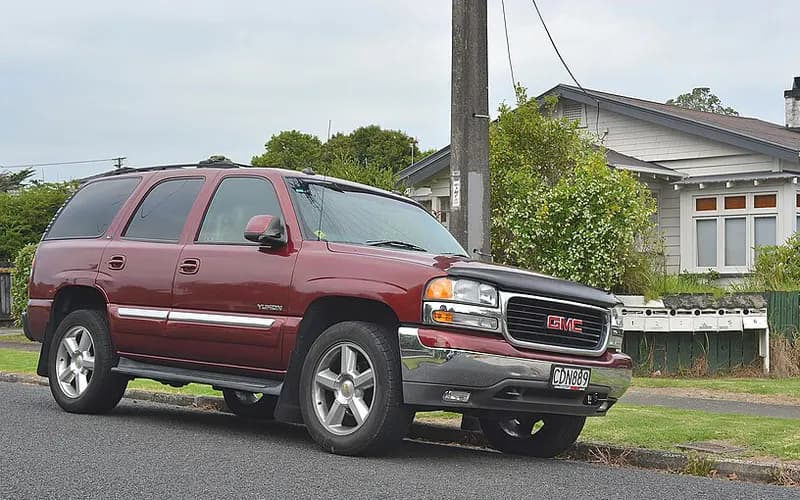
Common on this vehicle:Gauge or instrument faultNoiseWarning lightCorrosion or rustLeakReduced brakingAir conditioning or heaterVibration or shudder
Possible causes
27 causes not drawn
- Engine knock on cold start (carbon on piston)0
- Rear door window inoperative (motor replacement)2
- Rattle from the center of the dash (cowl insulator clip)1
- RPO DL3 power folding mirror loose, moves or shakes after being folded by hand (cycle it electrically)1
- Snap or popping noise from the front of the vehicle (slot the front crossmember mounting holes)1
- Headliner or roof rattle (roof drain channel)1
- Side access door noise (door check link replacement)1
- Power Window2
- Tire recall (not the vehicle as built): Firestone Wilderness LE tread separation - recall 01T-0012
- Generator whine in the audio system (new ground for radio and amplifier)1
- CD slow to play, CHECK CD error, CD stuck or clock resets to 12:00 (reprogram the radio, do not replace it)1
- Hum or fan noise from the navigation radio (internal cooling fan, normal)1
- Radio volume lower at the same setting after reprogramming or replacement (new audio calibration, normal)1
- Battery1
- Cigarette Lighter1
- Aftermarket part (not the vehicle as built): Federal-Mogul National / Carquest replacement wheel hub assembly retention nut - recall 07E-1061
- Grease seen at front hub bearing seals (normal purge, do not replace)1
- Creak or squeak noise from the rear lower control arm bushings (do not replace the propshaft)1
- Control Arm1
- Rear Leaf Spring1
- 4L80-E / 4L85-E planetary gear whine in first and second gear1
- 4L60-E / 4L65-E clunk on 2-3 upshift or 3-2 downshift (normal condition)1
- Grind / ratchet noise when shifting into Park in 4LO (characteristic)1
- Transfer Case Chain1
- Aftermarket part (not the vehicle as built): Fram G3727 replacement fuel filter connector - recall 06E-0431
- Fuel pressure regulator buzz / hum after replacement (check fuel pump feed voltage drop and connector crimps)1
- Seat Belt1
The documents say what to doOnly records name itThe size of a node, the width of a link and the numbers are records matching this search, not likelihoods.
FaultCrate・GMC Yukon 2000–2006・Noise
Candidate cause (the documents say what to do)
Rear bank knock sensor corrosion from water intrusion (P0332)
Customers may report mild to severe engine ping (spark knock), usually worse during acceleration, and/or an illuminated MIL.
The technician may find DTC P0332 set.
How to tell
P0327P0332Check engine / Service Engine Soon
What to do
- If P0327 and P0332 set at the same time, inspect for poor connections at the two-wire knock sensor harness located at the left rear side of the intake manifold near the top, just under the cover.
- Check the resistance of the knock sensors including the harness before reinstalling the intake manifold.
- Replace the rear bank knock sensor and build an RTV dam around the sensor to divert water away from it.
Caution: Do not form the RTV into a complete circle; leave the rear section open.
In the records
No record states work done for this cause.
See the evidence (1 technical documents, 0 records)
Passages of the technical documents
1999-2002 Chevrolet and GMC C/K Pickup and Utility Models (Avalanche, Silverado, Sierra, Tahoe, Suburban, Yukon, Yukon XL, Yukon Denali, Yukon Denali XL) with 4.8L, 5.3L or 6.0L Engine
General Motors (copy hosted by Corvette Action Center)
Some customers may comment on a mild to severe engine ping (commonly referred to as spark knock), usually worse during acceleration and/or an illuminated MIL.
General Motors (copy hosted by Corvette Action Center)
Upon investigation, the technician may find DTC P0332 set.
General Motors (copy hosted by Corvette Action Center)
This condition may be the result of corrosion of the rear bank knock sensor due to water intrusion into the sensor cavity.
General Motors (copy hosted by Corvette Action Center)
A cause or a result a complaint states is the owner’s view or what a dealer told them, not an established fact.
Put together by FaultCrate from public records and technical documents. The cause and the repair are for the workshop to decide with the vehicle in front of it. Counts are records, not failure rates.