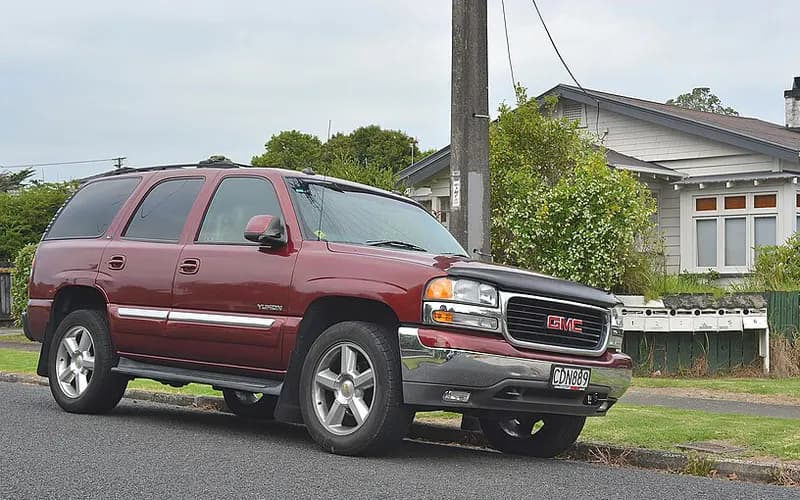
GMC Yukon 2000–2006
Common on this vehicle:Gauge or instrument faultNoiseWarning lightCorrosion or rustLeakReduced brakingAir conditioning or heaterVibration or shudder
Possible causes
27 causes not drawn
- Engine knock on cold start (carbon on piston)0
- Rear door window inoperative (motor replacement)2
- Rattle from the center of the dash (cowl insulator clip)1
- RPO DL3 power folding mirror loose, moves or shakes after being folded by hand (cycle it electrically)1
- Snap or popping noise from the front of the vehicle (slot the front crossmember mounting holes)1
- Headliner or roof rattle (roof drain channel)1
- Side access door noise (door check link replacement)1
- Power Window2
- Tire recall (not the vehicle as built): Firestone Wilderness LE tread separation - recall 01T-0012
- Generator whine in the audio system (new ground for radio and amplifier)1
- CD slow to play, CHECK CD error, CD stuck or clock resets to 12:00 (reprogram the radio, do not replace it)1
- Hum or fan noise from the navigation radio (internal cooling fan, normal)1
- Radio volume lower at the same setting after reprogramming or replacement (new audio calibration, normal)1
- Battery1
- Cigarette Lighter1
- Aftermarket part (not the vehicle as built): Federal-Mogul National / Carquest replacement wheel hub assembly retention nut - recall 07E-1061
- Grease seen at front hub bearing seals (normal purge, do not replace)1
- Creak or squeak noise from the rear lower control arm bushings (do not replace the propshaft)1
- Control Arm1
- Rear Leaf Spring1
- 4L80-E / 4L85-E planetary gear whine in first and second gear1
- 4L60-E / 4L65-E clunk on 2-3 upshift or 3-2 downshift (normal condition)1
- Grind / ratchet noise when shifting into Park in 4LO (characteristic)1
- Transfer Case Chain1
- Aftermarket part (not the vehicle as built): Fram G3727 replacement fuel filter connector - recall 06E-0431
- Fuel pressure regulator buzz / hum after replacement (check fuel pump feed voltage drop and connector crimps)1
- Seat Belt1
The documents say what to doOnly records name itThe size of a node, the width of a link and the numbers are records matching this search, not likelihoods.
FaultCrate・GMC Yukon 2000–2006・Noise
Candidate cause (the documents say what to do)
Tire scrub noise on low speed turns (steering rod / centerlink installed backwards)
The steering rod (centerlink) can be installed backwards on all trucks and utilities with recirculating ball type steering that do not use a steering dampener.
The idler and pitman attaching holes are tapered in only one direction.
What to do
- To determine the correct installation, compare with a like vehicle; correctly installed, the steering rod curves to the rear, outboard of the idler/pitman attachment holes and inboard of the inner tie rods.
- Installed incorrectly, the curved portion of the rod between the idler/pitman holes and the inner tie rods curves toward the front of the vehicle.
- Remove and correctly reinstall the steering rod (centerlink).
In the records
No record states work done for this cause.
See the evidence (1 technical documents, 1 records)
Passages of the technical documents
Owners of some 1999-2005 Full Size Trucks and Utilities may experience tire scrub noise on low speed turns (parking lot maneuvers).
General Motors 2004-10-01
The steering rod (centerlink) can be installed backwards on all trucks and utilities with recirculating ball type steering that do not use a steering dampener.
General Motors 2004-10-01
The idler and pitman attaching holes are tapered in only one direction.
General Motors 2004-10-01
To determine the correct installation of the steering rod, compare to a like vehicle. In a correct installation, the steering rod should curve to the rear, outboard of idler/pitman attachment holes and inboard of the inner tie rods.
General Motors 2004-10-01
A cause or a result a complaint states is the owner’s view or what a dealer told them, not an established fact.
Put together by FaultCrate from public records and technical documents. The cause and the repair are for the workshop to decide with the vehicle in front of it. Counts are records, not failure rates.