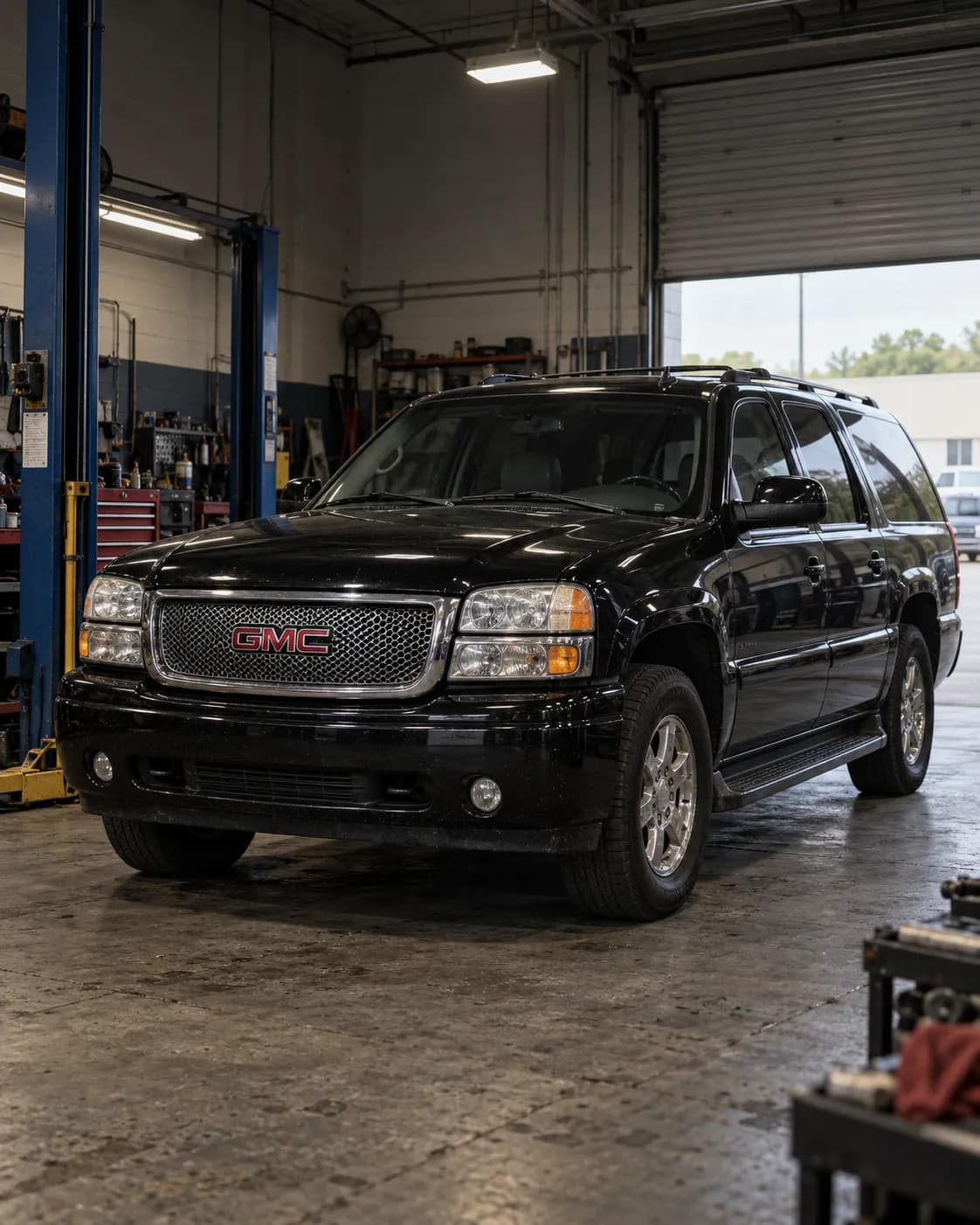
Source reference 11001321
Manufacturer communication — 2006 GMC YUKON DENALI XL
Relation to the target vehicle
- The source's vehicle field includes the trim.
- Model year
- Match 2006 — Source vehicle field
- Model
- Match YUKON DENALI XL — Source vehicle field
- Trim
- Match Denali — Source vehicle field
What the manufacturer’s document says
08-07-30-035H ・ fault and correction ・ for GM vehicles in general
Applies to
Applies to 2025 and prior GM passenger cars and trucks equipped with an automatic transmission.
the passage
2025 and Prior GM Passenger Cars and Trucks (including Chevrolet Medium Duty LCF Equipped with Gas Engine and 6L90 Transmission) Equipped with Automatic Transmission
Fault
Water or ethylene glycol in ATF changes the friction of the clutches, frequently causing shudder during engagement or gear changes, especially during torque converter clutch engagement.
the passage
Water or ethylene glycol in ATF will also change the friction of the clutches, frequently resulting in shudder during engagement or gear changes, especially during torque converter clutch engagement.
Finding the cause
Steps to confirm (in the document’s order)
An indication of water in the ATF: ATF blowing out of the transmission vent tube.
the passage
ATF blowing out of the transmission vent tube.
The ATF may appear cloudy or, with extreme contamination, look like a strawberry milkshake.
the passage
ATF may appear cloudy or, in cases of extreme contamination, have the appearance of a straw- berry milkshake.
There may be visible water in the oil pan or a milky white substance inside the pan area.
the passage
Visible water in the oil pan. • A milky white substance inside the pan area.
Spacer plate gaskets appear swollen or wrinkled in areas where they are not compressed.
the passage
Spacer plate gaskets that appear to be swollen or wrinkled in areas where they are not compressed.
If water is found in the ATF and its source is not identified, or a leaking in-radiator transmission oil cooler is suspected, a simple and quick test kit that detects ethylene glycol in ATF is available.
the passage
If water in the ATF has been found and the source of the water entry has not been identified, or if a leaking in-radiator transmission oil cooler is suspected (with no evidence of cross-contamination in the coolant recovery reservoir), a simple and quick test kit is available that detects the presence of ethylene glycol in ATF.
Obtain the Gly-Tek test kit from the Nelco Company and test the ATF to decide accurately whether the radiator needs to be replaced.
the passage
The “Gly-Tek” test kit, available from the Nelco Company, should be obtained and the ATF tested to make an accurate decision on the need for radiator replacement.
Correction
Repair
If water or coolant is found in the transmission, all rubber-type seals, all composition-faced clutch plates and/or bands, all nylon parts and the torque converter must be replaced.
the passage
If water or coolant is found in the trans- mission, the following components MUST be replaced. • Replace all of the rubber-type seals. • Replace all of the composition-faced clutch plates and/or bands. • Replace all of the nylon parts. • Replace the torque converter.
Thoroughly clean and rebuild the transmission, using new gaskets and oil filter.
the passage
Thoroughly clean and rebuild the transmission, using new gaskets and oil filter.
Flush and flow check the transmission oil cooler using J-45096.
the passage
Flush and flow check the transmission oil cooler using J-45096.
Thoroughly inspect the engine cooling system and hoses and clean/repair as necessary.
the passage
Thoroughly inspect the engine cooling system and hoses and clean/repair, as necessary.
Compiled by reading the full text of the document; each point stands on the passage shown. Check the document itself, linked below, before working on a vehicle.
Stated content
Communication summary
本サービスボレチンはトランスミッションフルード内の水またはエチレングリコールの有害な影響に関する情報を提供するものです。 Machine translation (unreviewed)
This bulletin provides information on the harmful effects of water or ethylene glycol in transmission fluid.
Go to this passage in the original
Source
- Source
- NHTSA Manufacturer Communications
- Source reference
- 11001321
- Received by source
- 2024-06-07
- Incident date
- Unknown
Open original text and sourceOpen the provider's page (external)