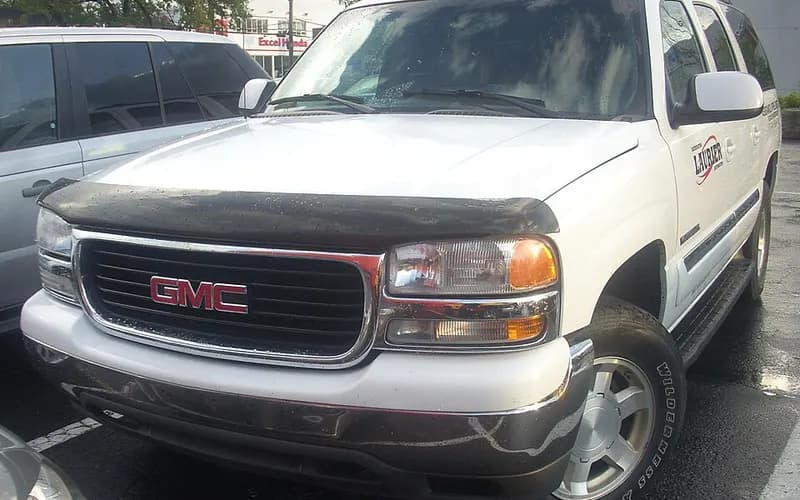
GMC Yukon XL 2000–2006
Common on this vehicle:NoiseWarning lightLoss of engine power, no accelerationVibration or shudderLeakShifting faultGauge or instrument faultParking brake
Possible causes
6 causes not drawn
- Throttle body carbon build-up: idle surge, reduced engine power, throttle DTCs (high mileage)0
- ABS lamp with DTC C0265 (EBCM motor relay circuit) after EBCM replacement0
- SIR lamp on and inside mirror temperature/compass display inoperative (open air bag fuse, circuit 1139 shorted to ground)0
- Air bag (SIR) lamp on with DTC B1001 after BCM or SDM replacement0
- Autoride (Z55) Service Ride Control / Service Suspension System message0
- Aftermarket part (not the vehicle as built): Federal-Mogul National / Carquest replacement wheel hub assembly retention nut - recall 07E-1062WD only0
Causes with no correction stated (5)
Causes the records name for which no check or repair is stated, in a technical document or in a record. Press one for the records that name it.
The documents say what to doOnly records name itThe size of a node, the width of a link and the numbers are records matching this search, not likelihoods.
FaultCrate・GMC Yukon XL 2000–2006・Warning light, Transmission and driveline
Candidate cause (the documents say what to do)
Reduced Engine Power from throttle body connector crimp, broken wire or grounds
A vehicle may come in for a reduced power message and DTCs P0120, P0220, P1516, P2101 or P2135.
The TAC / throttle body codes may be caused by a loose wiring crimp at the throttle body connector or a broken throttle body circuit.
How to tell
P0120P0220P1516P2101P2135Check engine / Service Engine SoonReduced Engine Power
What to do
- Inspect all related throttle body terminals for a loose wiring crimp.
- Wire breaks usually occur within 1 to 4 inches (= 25.4–101.6 mm) of the throttle body connector.
- On C/K trucks, complete SI procedures for voltage drop on grounds G103 and G104; grounds G103 or G104 may be loose or corroded.
- If a terminal crimp or broken wire is found, repair or replace only the circuits involved.
Caution: Installing this pigtail connector may cause other intermittent TAC module / TP codes at a later date.
What is needed
- Parts and materials
- Not stated
- Labor time
- Not stated
- Special tools
- Not stated
- Scan tool
- Not stated
Only what the technical documents state. "Not stated" does not mean not needed.
In the records
- Sensor: cleaned 1(says it did not fix it: 1)
- Throttle Body Harness: replaced 1(says it did not fix it: 1)
- Throttle Body Sensor: replaced 1(says it did not fix it: 1)
See the evidence (1 technical documents, 1 records)
Passages of the technical documents
The bulletin covers 2003-2006 GMC Envoy, Savana, Sierra and Yukon.
2003-2006 GMC Envoy, Savana, Sierra, Yukon
General Motors (copy hosted by simple-engineering.com) 2006-10-31
It applies to vehicles with a 4.8, 5.3, 6.0 or 7.0 V-8 engine.
Equipped with a 4.8 5.3 6.0 or 7.0 V-8 Engine
General Motors (copy hosted by simple-engineering.com) 2006-10-31
A vehicle may come in for a reduced power message and DTCs P0120, P0220, P1516, P2101 or P2135.
A vehicle may be brought into the dealer for a reduced power message, and DTCs P0120, P0220, P1516, P2101, or P2135.
General Motors (copy hosted by simple-engineering.com) 2006-10-31
The TAC / throttle body codes may be caused by a loose wiring crimp at the throttle body connector or a broken throttle body circuit.
The Throttle Actuator Control (TAC) / throttle body type trouble codes, may be caused by a loose wiring crimp at the throttle body connector, or a broken throttle body circuit.
General Motors (copy hosted by simple-engineering.com) 2006-10-31
Records
- Reduced engine power and service engine soon signals appearing repeatedly since September 2014 Owner complaint 2015-02-23
A cause or a result a complaint states is the owner’s view or what a dealer told them, not an established fact.
Put together by FaultCrate from public records and technical documents. The cause and the repair are for the workshop to decide with the vehicle in front of it. Counts are records, not failure rates.