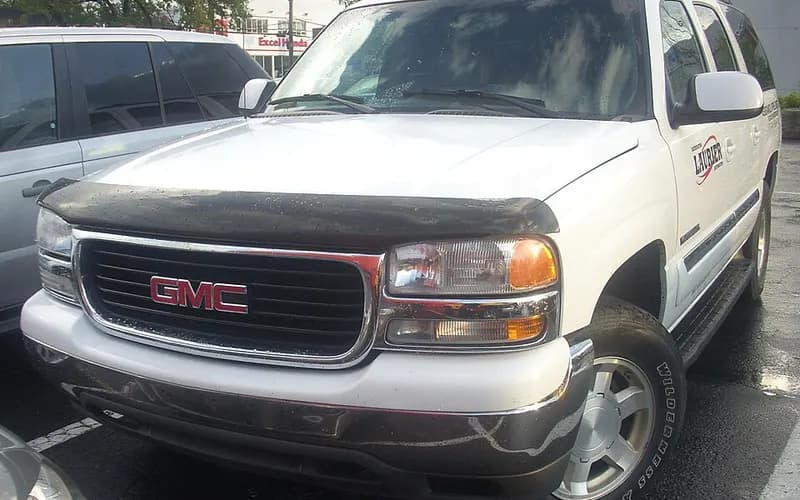
BrakesModel years 2000–2006Government
Brake pipe (brake line) corrosion and rupture
All GMT800 trucks and SUVs share the pipe design; NHTSA's investigation covered MY 1999-2003 vehicles sold or registered in 21 salt-belt states. GMC Yukon is listed as 2000-2006 in the GMT800 platform.
FaultCrate・Brake pipe (brake line) corrosion and rupture
A fluid level sensor or differential pressure switch lights the red BRAKE telltale on low fluid or a pressure difference between the two circuits.
The complaints allege loss of braking effectiveness from a brake line that ruptured because of corrosion; in 37 of them a dealer inspection confirmed the brake line failure.
In approximately 25 percent of the complaints the brake pipe failure allegedly occurred suddenly, with no brake warning light, and resulted in extended stopping distances.
The pipes' steel-copper construction is vulnerable to galvanic corrosion if exposed to the environment.
NHTSA found the failures came with general excessive corrosion over most of the pipe assembly and appear to be expected wear-out of the coating in severe-corrosion states.
GM changed to a NyGal coating system on the GMT900 series vehicles launched in MY 2007.
The ABS modulator is on the inboard side of the left frame rail beneath the driver's seating position. Pipes for both circuits run from the master cylinder to the modulator, and 3 pipes leave it: 2 forward to the left and right front calipers and 1 rearward along the left frame.
The brake pipes are copper brazed, double-wall steel tubes (Bundy tubes) supplied by TI Automotive.
The pipes use an AlGal coating: a hot-dipped inner sacrificial layer (95% zinc and 5% aluminum Galfan) under an aluminum rich paint outer barrier layer.
ODI found that the coating system used for the outer barrier layer appears to be the most significant design factor in the pipes' corrosion resistance.
The plastic (nylon) outer coating of the later NyGal system is substantially (50x) thicker and is a stronger barrier against damage from tire kick-up such as stone pecking than the aluminum paint of the AlGal coating.
When the BRAKE telltale is lit for a partial system failure, the rear ABS algorithm changes to a more aggressive control logic that puts stopping performance ahead of stability.
The corrosion seen in incident vehicles was general corrosion affecting most of the pipe assembly and other underbody components, not localized corrosion pointing to a routing or retention problem.
How to tell
What to do
- In the joint inspections, scaling or flaking corrosion was taken as indicating the onset of metal loss and given the second lowest ranking (2); a leaking or previously repaired pipe was the lowest (1).
- GM noted that pipes with excessive flaking corrosion can only be fully evaluated, including remaining service life, by removing them, cleaning off the corrosion and sectioning them to assess remaining wall thickness.
- The inspections found no specific location where corrosion was visually more severe and no pattern between vehicles.
- Service records of incident vehicles also indicate that repairs are not isolated to a specific location or brake pipe.
- GM recommends replacing the entire set of pipes whenever any pipe leaks or is corroded enough to need replacement.
- On June 28, 2013 GM released 66 new part numbers for servicing brake pipes in 1999-2007 GMT800 pickups and utility vehicles.
- GM's brake pipe kits contain a complete set of pre-formed and pre-flared pipes for virtually every design configuration, for use any time the entire brake pipe assembly has to be replaced.
- GM issued TSB 13-05-22-001, "Pre-Formed and Pre-Flared Hydraulic Brake Pipe Kits Now Available for Service", in November 2013, with the Brake Line Kit Installation service procedure.
- The October 2014 version of the TSB gives a labor time guideline of 4.5 to 6.0 hours for the kit procedure, depending on the vehicle's configuration.
- Forming and flaring replacement tubing to fit the vehicle has a base time estimate of approximately 8.5 hours; the kits reduce the labor time because no forming, bending or flaring is required.
If left
- Corroded brake lines may rupture during a brake application, reducing brake effectiveness.→ reduced brake effectiveness (loss of one hydraulic circuit)
- The worst case is failure of the front circuit (rear-only braking) with a lightly loaded vehicle.→ rear-only braking (front circuit failed)
- GM stated that the brake system is split front/rear and that, should a brake pipe suddenly fail, the vehicle would be capable of stopping with the pressure supplied by the remaining circuit.
- Most of the failures reported to ODI occurred in vehicles with more than 10 years in service.
Caution
- Analysis of repair records indicates that consumers often elect to repair only the failed circuit.
- A safety-related defect has not been identified at this time.
- In the inspections of subject and peer (Ford and Chrysler) vehicles the results were similar for each manufacturer; vehicle age was a significant factor in having a prior brake pipe repair and in severe flaking corrosion.
- The AlGal coating was the most common in the industry for full-size pickups and utilities in the late 1990's, and inspection and survey data showed no significant difference between the subject vehicles and peer vehicles with AlGal coated pipes, adjusted for vehicle age.
- NHTSA states that closing the investigation is not a finding that a safety-related defect does not exist.
In the records
- Brake Line: replaced 23(result not stated: 23)
- Brake Rotor: replaced 2(result not stated: 2)
- Caliper: replaced 2(says it was fixed: 1, result not stated: 1)
- Parking Brake Shoe: replaced 2(result not stated: 2)
Applies to
- NHTSA's investigation covered 1999-2003 GM C/K pickups and SUVs in salt-belt states.
- The GMT800 platform includes 1999-2007 Silverado and Sierra 1500, 2500 and 3500 pickup trucks; 2000-2006 Suburban, Tahoe and Yukon; and 2002-2006 Escalade and Avalanche.
- Complaint rates were minimal in all regions for vehicles with less than 8 years of service.
- In the salt states the complaint rate goes from less than 0.1 incident per thousand vehicles at 7 years in service to over 1.0 per thousand after the 12th year of service for the subject pickup trucks and utility vehicles.
- ODI has received 110 owner complaints for MY 1999 through 2003 Chevrolet and GMC C/K series pickup trucks and sport utility vehicles, including 3 involving MY 2003 2500 series heavy-duty pickup trucks.
- ODI's and GM's analysis indicates that 85 percent of the complaints occurred on vehicles used primarily in states that use salt on the roads in winter.
- There are 66 different brake pipe routing configurations in the subject vehicles, but all GMT800 vehicles share the same basic brake pipe configuration.
- Manufacturers changed to plastic coated lines with a new platform or a new brake line release; ODI gives GM's rear brake line change in MY05 (rear disc to rear drum brakes) as an example.
- For the approximately 10.4 million MY 1999 through 2007 GMT800 vehicles sold in the United States, ODI identified 3,645 complaints of brake pipe corrosion failures, including 107 alleging crashes.
- ODI's analysis identified no significant differences in failure rates between body types, brake pipe configurations or build range.
- Among the salt states, those without inspection programs (Connecticut, Maryland and New Jersey) had the highest rates, which ODI reads as indicating that inspections may be partially helpful in reducing the risk of brake pipe failure.
See the evidence (4 documents, 43 passages)
| Document | Publisher | Date |
|---|---|---|
| [1]ODI Resume, EA 11-001 Close: Brake line corrosion failure ↗ | GovernmentNHTSA ODI | 2015-04-08 |
| [2]Engineering Analysis Closing Report EA11-001: Brake pipe corrosion failures in MY 1999-2003 GM GMT800 pickups and SUVs in salt states ↗ | GovernmentNHTSA ODI | 2015-04-09 |
| [3]ODI investigation PE10010: Brake line corrosion failure ↗ | GovernmentNHTSA ODI | 2011-01-05 |
| [4]ODI investigation EA11001: Brake line corrosion failure ↗ | GovernmentNHTSA ODI | 2015-04-08 |
Applies toNHTSA's investigation covered 1999-2003 GM C/K pickups and SUVs in salt-belt states.
Products: 1999-2003 GM C/K pickup trucks and SUVs in Salt Belt states— [1] resume p.1
Applies toThe GMT800 platform includes 1999-2007 Silverado and Sierra 1500, 2500 and 3500 pickup trucks; 2000-2006 Suburban, Tahoe and Yukon; and 2002-2006 Escalade and Avalanche.
The GMT800 platform includes the following vehicles: 1999-2007 Chevrolet Silverado and GMC Sierra 1500, 2500 and 3500 series pick-up trucks; 2000-2006 Chevrolet Suburban, Chevrolet Tahoe and GMC Yukon sport utility vehicles; and 2002-2006 Cadillac Escalade and Chevrolet Avalanche sport-utility vehicles.— [1] resume p.1
If leftCorroded brake lines may rupture during a brake application, reducing brake effectiveness.
Brake line corrosion may result in rupture during brake application, resulting in reduced brake effectiveness.— [1] resume p.1
Why it happensThe pipes' steel-copper construction is vulnerable to galvanic corrosion if exposed to the environment.
The steel-copper construction is vulnerable to galvanic corrosion if exposed to the environment.— [2] closing report p.4
Why it happensNHTSA found the failures came with general excessive corrosion over most of the pipe assembly and appear to be expected wear-out of the coating in severe-corrosion states.
The investigation found that vehicles experiencing brake pipe corrosion failures were likely to have general patterns of excessive corrosion on the majority of the brake pipe assembly and appear to be occurring due to expected wear out for the brake pipe coating material used in the subject vehicles and the environmental conditions in severe corrosion states.— [1] resume p.2
Applies toComplaint rates were minimal in all regions for vehicles with less than 8 years of service.
For vehicles with less than 8 years of service, the complaint rates were minimal for all regions.— [1] resume p.2
Applies toIn the salt states the complaint rate goes from less than 0.1 incident per thousand vehicles at 7 years in service to over 1.0 per thousand after the 12th year of service for the subject pickup trucks and utility vehicles.
The complaint rates in the salt states go from less than 0.1 incident per thousand vehicles (IPTV) at 7 years in service to over 1.0 IPTV after the 12th year of service for the subject pickup trucks and utility vehicles.— [1] resume p.2
First signsA fluid level sensor or differential pressure switch lights the red BRAKE telltale on low fluid or a pressure difference between the two circuits.
Depending on the model and model year, the subject vehicles are equipped with a master cylinder reservoir fluid level sensor or a differential pressure switch that will illuminate the red BRAKE telltale in the instrument cluster when they are activated by a low fluid level or a pressure differential between the primary and secondary circuits.— [2] closing report p.3
If leftThe worst case is failure of the front circuit (rear-only braking) with a lightly loaded vehicle.
The worst case condition for each vehicle is front circuit failure (rear only braking) with light vehicle load.— [2] closing report
RepairGM recommends replacing the entire set of pipes whenever any pipe leaks or is corroded enough to need replacement.
GM recommends replacing the entire set of pipes whenever any pipe is leaking or exhibits corrosion severe enough to require replacement.— [2] closing report p.10
RepairOn June 28, 2013 GM released 66 new part numbers for servicing brake pipes in 1999-2007 GMT800 pickups and utility vehicles.
On June 28, 2013, GM released 66 new part numbers for servicing brake pipes in 1999 through 2007 GMT800 pickup trucks and utility vehicles.— [2] closing report p.10
CautionAnalysis of repair records indicates that consumers often elect to repair only the failed circuit.
Analysis of repair records submitted with some complaints indicates that consumers often elect to repair only the failed circuit.— [2] closing report p.10
CautionA safety-related defect has not been identified at this time.
A safety-related defect has not been identified at this time.— [1] resume p.2
Why it happensGM changed to a NyGal coating system on the GMT900 series vehicles launched in MY 2007.
General Motors changed to a NyGal coating system in the GMT900 series vehicles, which were launched in MY 2007.— [2] closing report p.4
Applies toODI has received 110 owner complaints for MY 1999 through 2003 Chevrolet and GMC C/K series pickup trucks and sport utility vehicles, including 3 involving MY 2003 2500 series heavy-duty pickup trucks.
ODI has received 110 owner complaints for MY 1999 through 2003 Chevrolet and GMC C/K series pickup trucks and sport utility vehicles, including 3 involving MY 2003 2500 series heavy-duty pickup trucks.— [3]
First signsThe complaints allege loss of braking effectiveness from a brake line that ruptured because of corrosion; in 37 of them a dealer inspection confirmed the brake line failure.
The complaints allege the loss of braking effectiveness due to brake line rupture because of corrosion. In 37 of these complaints, the brake line failure was confirmed by a dealer inspection.— [3]
Applies toODI's and GM's analysis indicates that 85 percent of the complaints occurred on vehicles used primarily in states that use salt on the roads in winter.
ODI's and GM's analysis indicates that 85 percent of the complaints occurred on vehicles used primarily in States that use salt on the roads during Winter months— [3]
First signsIn approximately 25 percent of the complaints the brake pipe failure allegedly occurred suddenly, with no brake warning light, and resulted in extended stopping distances.
In approximately 25 percent of the complaints, the brake pipe failure has allegedly occurred suddenly, with no warning to the driver (i.e., no brake warning light), and resulted in extended stopping distances.— [4]
If leftGM stated that the brake system is split front/rear and that, should a brake pipe suddenly fail, the vehicle would be capable of stopping with the pressure supplied by the remaining circuit.
(1) the brake system of the subject vehicles is split front/rear and should a brake pipe suddenly fail for any reason, the affected vehicle would be capable of stopping with the pressure supplied by the remaining circuit— [4]
Applies toThere are 66 different brake pipe routing configurations in the subject vehicles, but all GMT800 vehicles share the same basic brake pipe configuration.
There are 66 different brake pipe routing configurations used in the subject vehicles, but all GMT800 vehicles share the same basic brake pipe configuration as shown in Figure A3 in the Appendix.— [4]
Why it happensThe ABS modulator is on the inboard side of the left frame rail beneath the driver's seating position. Pipes for both circuits run from the master cylinder to the modulator, and 3 pipes leave it: 2 forward to the left and right front calipers and 1 rearward along the left frame.
The ABS modulator is located on the in-board side of the left frame rail beneath the driver’s seating position. The pipes for the primary (front) and secondary (rear) circuits run from the master cylinder to the front face of the modulator and 3 pipes run from the upper front face of the modulator to the brakes, 2 routed forward to the left and right front brake calipers and 1 routed rearward along the left frame (Figure 3).— [4]
Why it happensThe brake pipes are copper brazed, double-wall steel tubes (Bundy tubes) supplied by TI Automotive.
The brake pipes used in the subject vehicles are copper brazed, double-wall steel tubes (Bundy tubes) supplied by TI Automotive.— [4]
Why it happensThe pipes use an AlGal coating: a hot-dipped inner sacrificial layer (95% zinc and 5% aluminum Galfan) under an aluminum rich paint outer barrier layer.
The subject brake pipes use an AlGal coating for protection against corrosion and abrasion. The AlGal coating system consists of a hot-dipped alloy inner sacrificial layer (95% zinc and 5% aluminum Galfan coating) and an aluminum rich paint outer barrier layer (Figure 5).— [4]
Why it happensODI found that the coating system used for the outer barrier layer appears to be the most significant design factor in the pipes' corrosion resistance.
The coating system used for the outer barrier layer appears to be the most significant design factor affecting the corrosion resistance of the brake pipes.— [4]
Why it happensThe plastic (nylon) outer coating of the later NyGal system is substantially (50x) thicker and is a stronger barrier against damage from tire kick-up such as stone pecking than the aluminum paint of the AlGal coating.
The plastic coating is substantially (50x) thicker and provides a stronger barrier against damage from exposure to tire kick-up (e.g., stone pecking) than the aluminum paint used in the AlGal coating.— [4]
Applies toManufacturers changed to plastic coated lines with a new platform or a new brake line release; ODI gives GM's rear brake line change in MY05 (rear disc to rear drum brakes) as an example.
Each company implemented the changeovers to plastic coated lines with either a new platform launch or a new brake line release (e.g., GM’s rear brake line change in MY05 to accommodate change from rear disc to rear drum brakes).— [4]
Why it happensWhen the BRAKE telltale is lit for a partial system failure, the rear ABS algorithm changes to a more aggressive control logic that puts stopping performance ahead of stability.
When the system detects a partial system failure (i.e., the BRAKE telltale is illuminated), the ABS algorithm for the rear brakes changes to a more aggressive control logic prioritizing stopping performance over stability.— [4]
If leftMost of the failures reported to ODI occurred in vehicles with more than 10 years in service.
Most of the failures reported to ODI occurred in vehicles with more than 10 years in service.— [4]
How to confirmIn the joint inspections, scaling or flaking corrosion was taken as indicating the onset of metal loss and given the second lowest ranking (2); a leaking or previously repaired pipe was the lowest (1).
Vehicles with no visible brake pipe corrosion were given the highest ranking (10) and vehicles with at least one brake pipe leaking or previously repaired/replaced were given the lowest ranking (1). Vehicles with scaling/flaking corrosion indicating onset of metal loss were given the second lowest ranking (2).— [4]
How to confirmGM noted that pipes with excessive flaking corrosion can only be fully evaluated, including remaining service life, by removing them, cleaning off the corrosion and sectioning them to assess remaining wall thickness.
As noted by GM, brake pipes with excessive flaking corrosion can only be fully evaluated, including estimations of remaining service life, by removing them from the vehicle, cleaning the corrosion from the pipes and sectioning the pipes to assess remaining wall thickness.— [4]
How to confirmThe inspections found no specific location where corrosion was visually more severe and no pattern between vehicles.
The inspections did not identify any specific locations where corrosion was visually more severe in any of the inspected vehicles nor were any patterns evident between vehicles.— [4]
How to confirmService records of incident vehicles also indicate that repairs are not isolated to a specific location or brake pipe.
In addition, analysis of incident vehicle service records also indicates that repairs are not isolated to a specific location or brake pipe.— [4]
Why it happensThe corrosion seen in incident vehicles was general corrosion affecting most of the pipe assembly and other underbody components, not localized corrosion pointing to a routing or retention problem.
The corrosion observed in incident vehicles was general corrosion affecting most of the pipe assembly, as well as other underbody components on the vehicle, and not localized corrosion indicative of a design or manufacturing problem in the routing or retention of the pipes.— [4]
CautionIn the inspections of subject and peer (Ford and Chrysler) vehicles the results were similar for each manufacturer; vehicle age was a significant factor in having a prior brake pipe repair and in severe flaking corrosion.
The inspections found similar results for each manufacturer, with vehicle age a significant factor in the likelihood of having a prior brake pipe repair and for exhibiting severe flaking corrosion of some section of brake pipes.— [4]
CautionThe AlGal coating was the most common in the industry for full-size pickups and utilities in the late 1990's, and inspection and survey data showed no significant difference between the subject vehicles and peer vehicles with AlGal coated pipes, adjusted for vehicle age.
The coating was the most common in industry for full-size pickups and utilities when the subject vehicles were design and launched in the late 1990’s and analysis of inspection and survey data did not indicate a significant difference between the subject and peer vehicles using AlGal coated brake pipes in the likelihood of finding prior brake pipe repair or significant brake pipe corrosion adjusted for vehicle age.— [4]
Applies toFor the approximately 10.4 million MY 1999 through 2007 GMT800 vehicles sold in the United States, ODI identified 3,645 complaints of brake pipe corrosion failures, including 107 alleging crashes.
ODI reviewed design, testing and field data regarding the approximately 10.4 million MY 1999 through 2007 GMT800 vehicles sold in the United States. The analysis identified 3,645 complaints of brake pipe corrosion failures in these vehicles, including 107 alleging crashes.— [4]
Applies toODI's analysis identified no significant differences in failure rates between body types, brake pipe configurations or build range.
No significant differences in failure rates between body types, brake pipe configurations or build range were identified in ODI’s analysis.— [4]
Applies toAmong the salt states, those without inspection programs (Connecticut, Maryland and New Jersey) had the highest rates, which ODI reads as indicating that inspections may be partially helpful in reducing the risk of brake pipe failure.
The states without inspection programs (Connecticut, Maryland and New Jersey) had the highest rates, indicating that inspections may be partially helpful in reducing the risk of brake pipe failure.— [4]
RepairGM's brake pipe kits contain a complete set of pre-formed and pre-flared pipes for virtually every design configuration, for use any time the entire brake pipe assembly has to be replaced.
The kits include a complete set of pre-formed and pre-flared hydraulic brake pipes for virtually every design configuration of the subject vehicles. The kits are intended for use any time replacement of the entire brake pipe assembly is required.— [4]
RepairGM issued TSB 13-05-22-001, "Pre-Formed and Pre-Flared Hydraulic Brake Pipe Kits Now Available for Service", in November 2013, with the Brake Line Kit Installation service procedure.
GM issued Technical Service Bulletin (TSB) 13-05-22-001, “Pre-Formed and Pre-Flared Hydraulic Brake Pipe Kits Now Available for Service”, in November 2013 to inform dealers of an improved service strategy to aid in the replacement of hydraulic brake pipes utilizing brake pipe kits including the newly developed Brake Line Kit Installation service procedure.— [4]
RepairThe October 2014 version of the TSB gives a labor time guideline of 4.5 to 6.0 hours for the kit procedure, depending on the vehicle's configuration.
The TSB was reissued three times, with the most recent version in October 2014 including a labor time guideline for the procedure (4.5 to 6.0 hours, depending on the vehicle’s configuration).— [4]
RepairForming and flaring replacement tubing to fit the vehicle has a base time estimate of approximately 8.5 hours; the kits reduce the labor time because no forming, bending or flaring is required.
The base time estimate for performing this work is approximately 8.5 hours. The GM brake pipe kits reduce the labor time for complete pipe replacement, as no forming/bending or flaring is required.— [4]
CautionNHTSA states that closing the investigation is not a finding that a safety-related defect does not exist.
The closing of this investigation does not constitute a finding by NHTSA that a safety-related defect does not exist.— [4]
Put together by FaultCrate from public records and technical documents. The cause and the repair are for the workshop to decide with the vehicle in front of it. Counts are records, not failure rates.
List the records (40 that can be opened)
Records whose recall number, document number or text matches. Each line says why it matched.
- Brake failure due to leak from rusted brake line under driver seat areaOwner complaint 2019-10-08・text contains "BRAKE LINE"
- Brake line failure and brake pedal to floor while drivingOwner complaint 2018-07-12・text contains "BRAKE LINE"
- Complete brake failure due to corroded brake lines and master cylinder fluid lossOwner complaint 2017-09-19・text contains "BRAKE LINES"
- Brake lines rusted and leaking; brake pads, rotors, seals and gasket replacedOwner complaint 2017-07-31・text contains "BRAKE LINES"
- Brake line failure with complete loss of braking abilityOwner complaint 2017-02-06・text contains "BRAKE LINE"
- Front brake line from ABS module broke while towing, pedal went to floorOwner complaint 2017-01-11・text contains "BRAKE LINES"
- Corroded brake lines with loss of brakes and ABS sensor issueOwner complaint 2017-01-05・text contains "BRAKE LINES"
- Rusty brake lines causing complete brake failureOwner complaint 2016-10-12・text contains "BRAKE LINES"
- Brake line failure while driving in city streetOwner complaint 2016-10-03・text contains "BRAKE LINE"
- Brake line failure recurring two years after previous failureOwner complaint 2016-03-14・text contains "BRAKE LINES"
- Brake pedal loss of stopping power after parkingOwner complaint 2016-02-16・text contains "BRAKE LINE"
- White smoke from engine compartment and brake line corrosion and failureOwner complaint 2015-12-24・text contains "BRAKE LINES"
- Brake pedal went to the floor; rusted brake line burstOwner complaint 2015-11-28・text contains "BRAKE LINE"
- Rusted brake linesOwner complaint 2015-11-04・text contains "BRAKE LINES"
- Brake pedal went to floor when braking; brake fluid low and leak found on rusted brake lineOwner complaint 2015-10-12・text contains "BRAKE LINE"
- Brake line leaks from corrosion, brake failure, stability control failure, and instrument cluster gauge malfunctionOwner complaint 2015-10-06・text contains "BRAKE LINES"
- Steel brake lines rusted through, brake fluid leakage and total brake failureOwner complaint 2015-09-30・text contains "BRAKE LINES"
- Instrument panel went black while driving, ほかOwner complaint 2015-09-17・text contains "BRAKE LINES"
- Complete brake failure while driving; corroded brake linesOwner complaint 2015-08-15・text contains "BRAKE LINES"
- Brake pedal to floor, brake line rupture, and brake warning lightOwner complaint 2015-08-05・text contains "BRAKE LINE"
- Brake pedal went to floor and vehicle crashed into stop signOwner complaint 2015-06-22・text contains "BRAKE LINE"
- Rusted brake lines on 2006 DenaliOwner complaint 2015-06-22・text contains "BRAKE LINES"
- Brake pedal to floor - brake lines burst from rustOwner complaint 2015-04-11・text contains "BRAKE LINES"
- Brake pedal bottoms out with brake light onOwner complaint 2015-03-18・text contains "BRAKE LINES"
- Brake pedal went to floor at 45 mph due to corroded brake line failureOwner complaint 2015-01-27・text contains "BRAKE LINE"
- Brake failure on downhill road in winter conditionsOwner complaint 2015-01-26・text contains "BRAKE LINE"
- Brake line corroded and failed, resulting in brake loss and collision damageOwner complaint 2015-01-22・text contains "BRAKE PIPE"
- Brake failure at traffic lightsOwner complaint 2015-01-05・text contains "BRAKE LINES"
- Brakes stopped working while driving at 35 MPHOwner complaint 2015-01-02・text contains "BRAKE LINES"
- Brake pedal goes to floor, brake fluid loss, rusted brake line at left rearOwner complaint 2014-12-27・text contains "BRAKE LINES"
- Brake failure while driving home; brake lines flaking and leakingOwner complaint 2014-12-21・text contains "BRAKE LINES"
- Excessive corrosion on brake calipers, bleeders and bolts; brake lines rusted and leakingOwner complaint 2014-12-11・text contains "BRAKE LINES"
- Brake line failure when applied, rusted line causing leakOwner complaint 2014-12-02・tied by reading the record: “BRAKE FAILED WHEN APPLIED.MECHANIC SAID LINE IS RUSTED CAUSING LEAK.”
- Hydraulic brake lines rapidly corrodedOwner complaint 2014-12-01・text contains "BRAKE LINES"
- Brake lines rusted/corroded, replacement neededOwner complaint 2014-11-20・text contains "BRAKE LINES"
- Total brake failure due to brake line corrosionOwner complaint 2014-11-17・text contains "BRAKE LINE"
- Brakes did not work while driving; brake service warning light illuminatedOwner complaint 2014-11-10・text contains "BRAKE LINES"
- Brake lines failed due to corrosion; brake pedal went to floorOwner complaint 2014-11-04・text contains "BRAKE LINES"
- Brake pedal went to floor and brakes failed while turning into parking lotOwner complaint 2014-11-02・tied by reading the record: “THE REPAIR GARAGE CERTIFIED MECHANIC SAID THE BREAK LINE HAD RUSTED THRU AND THE BREAK FLUID WAS RAPIDLY LEAKING.”
- Brake pedal sinks to floor with minimal stopping ability when appliedOwner complaint 2014-10-14・text contains "BRAKE LINES"